How to Make a DIY Wood Brace Corbel for a Pergola or Arbor
Use a 2x6 or 2x8 board to make your own curved corbel DIY wood braces to support the vertical posts and horizontal beams of a pergola or arbor. These DIY wood braces look so much nicer than a regular diagonal knee brace board!
Equipment
- Speed square
- measuring tape
- Pencil
- 1 1/2" or longer screws
- PVC pipe or other bendable material
- Jigsaw and circular saw (optional)
Ingredients
- 2x6 or 2x8 board
Instructions
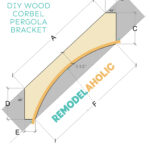
- Measure the distance the wood brace needs to span (A). This measurement MUST include the attachment points if the bracket will overlap a vertical or horizontal board rather than butting up against it.
- Mark a line that (A) length along one long edge of the board, in from the end 6-12 inches to allow for the ends of the corbel bracket section.
- At each end of the line, use a speed square to mark a line at 45-degrees (for a squared triangle brace) or 55-degrees for a brace that is slightly more vertical (such as the one I used to support the swing arbor rafters).
- At the top end of the corbel, mark along the line at the distance (B) to give the surface area you'll need to attach the corbel. The corbel could be attached at the top either butted up against the horizontal edge (with screws through the side of the board) or flat against the face of the horizontal beam/rafter (with screws through the face of the board).
- Next, use the speed square to mark a line at 90-degrees from that mark to the edge of the board. This is distance (C).
- At the bottom end of the corbel, mark along the line at the distance (D) that will allow for the attachment you need. [On the 45-degree wood braces we made, this distance (D) was the same as (C) which was gave the brackets a nice symmetry.]
- Use a speed square to mark a line at 90-degrees from that mark to the edge of the board. This is distance (E). [On both wood braces shown in the diagram, (C) and (E) are the same length; they don't have to be depending on the attachments needed.]
- Place one screw near the edge of the board, just past each of those two lines (noted by the green circles on the diagrams). These screws will help hold the material in place to trace the curve, so they should be placed so that the lower edge of the PVC pipe or whatever you are using intersects with that line at the edge of the board.
- Measure the distance between the 2 lines (F). Mark the point in the center were you want the deepest part of the curve (probably the center), then place a screw at that location 3 1/2" (or more) from the top edge of the board.
- Place the PVC pipe (or whatever bendable material you are using to trace the curve), shown as the yellow curve on the diagram, between the 3 screws and trace the curve.
- Once you've traced the pipe curve, you're ready to cut the corbel! Cut the straight ends carefully using a miter saw or jigsaw, then cut the curve with a jigsaw.
- Dry fit the corbel in place to see if any adjustments are needed.
- Trace the corbel pattern onto the other boards and cut as many corbels as you need.
Notes
