
Lace DIY Window Film


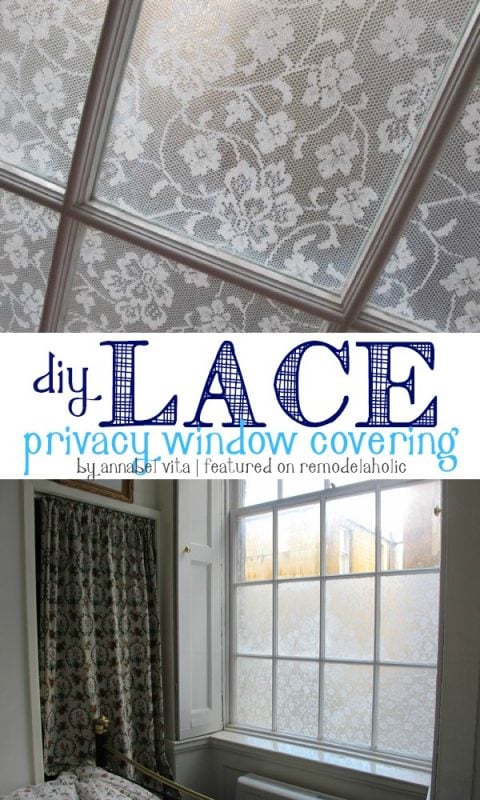
Add privacy but keep natural light with this lace DIY window film. Simple and inexpensive, you can totally get great results!
See all we have on windows, including: A New-Sew Magnetic Window Covering – How to Make and Install a Roman Blind – DIY Interior Window Shutters

How to DIY Window Film using Lace
by Annabel Vita

One day, with the help of this post from Manhattan Nest, I had a brainwave and added lace to the window with a pantry staple and some £1.50 lace from Ikea. Here’s how you can do the same.
DIY Window Film, Step 1: Prepare your lace.
I made a template of my window panes, but for a larger surface you could just measure it. Iron your lace if you can and trim it to size.

DIY Window Film, Step 2: Make up a starch jelly
First, mix two tablespoons cornflour (also known as cornstarch) and two tablespoons cold water until it forms a paste, then dissolve this in about a cup and a half of boiling water. You should end up with a nice gloopy liquid.
DIY Window Film, Step 3: Apply the jelly to the window
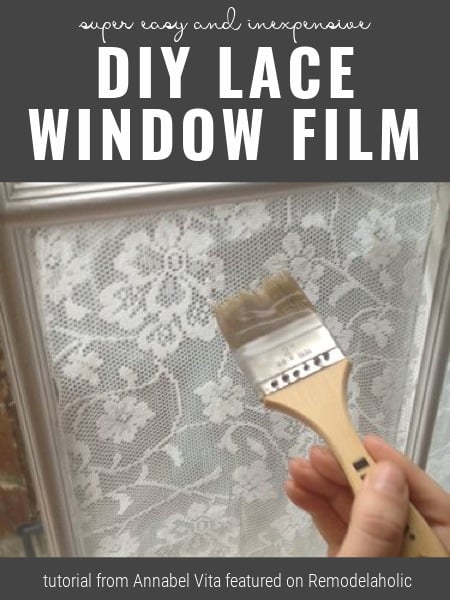
Use a brush to paint a thick layer of the gloopy jelly on to the window pane.

DIY Window Film, Step 4: Put lace in the window
Lay your fabric onto the pre-applied cornflour jelly.

DIY Window Film, Step 5: Brush on more jelly
Brush another layer of the jelly on top of the lace. Brush from the center to the corners but make your strokes slightly random. That way they won’t show too much when the jelly dries.
If your lace moves a bit, don’t worry! It’s easy to reposition at this point.
The best thing about using lace (with holes in) is that there are naturally no air pockets so you don’t have to bother with maneuvering bubbles to the edges to get them out.
DIY Window Film, Step 6: Let it dry
The starch jelly will take a while to fully dry out and it won’t be clear until it’s fully dry, so don’t panic if it looks a little white to begin with!

Q: Why did you need lace DIY Window Film?
A: Our old flat in a stately 1745 townhouse was packed with period features. The bedroom had delectable shutters, which I adored, but they made window treatments kind of hard. You either had to hang curtains in front of the whole alcove (we can tell by the holes in the trim that this is what our predecessors did) or not at all. For the last year and a bit, we’ve opted for nothing at all, except for a light-blocking curtain above the shutters. The shutters are great at blocking all natural light, which was great when we wanted it dark. But, the room got crazy beautiful morning light and it always seemed a shame to be getting dressed in artificial light just for the sake of privacy.

Q: Just how opaque is the lace DIY window film? I am curious how much privacy this actually offers.
A: I t totally depends on your fabric. If you’d be happy with getting changed behind the fabric as curtains then the fabric will be opaque enough for this window treatment too. I actually have lace curtains in this same fabric, and in both instances I feel happy getting changed behind them if it’s light outside. If it was dark outside and I had the light on, I wouldn’t be hanging out without my clothes. If privacy is really important for you, pick a lace that is more opaque than sheer.
Here’s a picture of my hand on the window…

…and held out as far away as it could go.

Q: What about mod podge? Would that work instead of cornflour?
A: We don’t really have modge podge here so I don’t know! It would be a bit more permanent I imagine. If it’s anything like PVA glue (I think it is) then I wouldn’t want to use it on wooden painted windows like we have, but it could work great on more modern windows. It would also be much more expensive. (The “glue” made out of cornstarch is essentially free!)
Q: If I used colored lace would the cornstarch show?
A: No, it dries totally clear (but goes on gloopy and white-ish, don’t panic!) It will probably go clear overnight.
Q: How do I clean it?
I would say it’s probably not great for a window that would get dirty a lot because you can dust or brush it but can’t wipe it down. I’d probably remove all the sheets of lace and run them through the machine in a lingerie bag every now and again and then put them back up. It’s that easy to apply.
Q: How do I remove the lace?
When it came to be time to move out, I sprayed the lace down with water and just pulled it away. There was a lot of residue on the window, but it soon came off with a scrubby sponge and VERY HOT water.

Thanks for reading! If you have any questions I will try and pop in to the comments here to answer them, or you may find the answer in the comments to this post.

More DIY window film ideas for privacy:
- DIY Window Privacy Film using Contact Paper
- Adding Privacy to Sidelights: Faux Stained Glass DIY
- How to DIY Faux Leaded Glass Windows
Please pin this for later! Also find more from Remodelaholic on Pinterest, YouTube, and Instagram.
Originally published 09.30.2014 // Updated 06.22.2021


I have tried this with liquid starch (in the laundry section) and it works quite well. It is also removable later. Fabric can be applied to walls also with liquid corn starch and it is premixed. This lace window is great and it will solve our problem for our bathroom window.
I absolutely love, love, love this! It is so simple and pretty but yet lets in some light while not having everything out there for the world to see.
Thanks for this great idea! I did it on the glass-paned door to my office and it was perfect. Exactly what the door needed for a bit of privacy but still letting in light.
So glad that it worked for you, Teresa! We’d love to see pictures, if you feel like sharing — you can message them to us over on Facebook or at hello@remodelaholic.com. Thanks!
Do you think a plastic lace would work as well? I think it is for tablecloths or shower curtains.
I’m not sure how well it would stick with the starch treatment — the starch seems to work because it dries and creates a bond between the material and the window, and I’m not sure it would do that with the plastic/vinyl type. If you’re talking about the solid sheet tablecloth type material that I’ve seen around, you might be able to get that to stick with just a bit of water, like a cling film? It’s worth a try either way! I’d love to hear your results.
plastic lace works GreaT!! I put it on a door and window using just water and it looks stupendous and doesn’t come off–it’s also wipeable. Plastic lace is harder to come by in my experience!
Thanks for the great idea. We have sidelights on our north facing front door, which are so narrow that I could not find tension/curtain rods to fit them anywhere. This was a life saver. I even used the exact same lace fabric from Ikea from my stash. Privacy while letting in much needed light. Thanks again.
WOW, this is a great idea. I covered my bathroom window in about an hour. It turned out great ! !
Hooray! We love hearing success stories. Thanks for reading!
This is a brilliant idea!! Thanks so much for sharing. Used it to solve the east morning sun glare from our big over-the bath window. God bless you heaps xo
You’re welcome!
Roaches are attracted to starch if you have roaches find another way to do this one.
Thanks for the tip, Rachael!
This is working terribly for me. I applied my lace panels to my windows less than a week ago. Had to re-apply 2 panels a total of three times then gave up because they kept peeling off. The other panels that have been holding up are slowly peeling off. Suggestions? I don’t understand why this is not working for me while ya’ll are claiming success. Extremely irritated.
Judging by the “y’all”, can I guess you live in the South? It may be the high humidity.
Long ago, when my kids were little, we decorated windows with baby shoe polish, white of course, and it would come off easily. You could apply it with Stencils, either purchased or hand-cut. I wonder if you could also use doilies as a stencil? I wish I knew what to suggest – I’m in MN.
This also worked fabulously for me…thanks so much for posting this idea. I saw similar things online using glue/Modge Podge, but I didn’t want to do it that way. Now I’m thinking of how else I can use this idea. 🙂
Thank you Cass and Annabel so much for this. I have been searching for a few months for a window treatment that doesn’t have PVC in it, and the only one I found costs way too much for me. This worked perfectly. I did have to use two pieces of lace because the window is really big. I had doubts it would work, but I’m so glad I tried. Now I can let the light in with a little privacy during the day. Such a small thing, yet so beautiful.
Blessings,
Robin
So glad you found us, Robin! Thanks for the comment!
Thank you for this great idea. It worked great for my kitchen as I needed a little privacy. The instructions were right on the mark. I happened to have lace and corn starch on hand, so started right away with the project. I ALWAYS have paint brushes on hand, but not one to be found. The lace was cut, the corn starch made, so I had to think quick! I have an over abundance of socks that don’t have mates and I said this will work. I smoothed the paste on the window with the cotton sock, applied the lace and blotted the remaining paste over the lace. Blotting was the trick and I can’t say how happy I am with the results.
Thank you for this tip.
So glad it worked well for you, Marie! Smart thinking putting those lone socks to use 🙂
I see in one photo there is a bit of lace over hang on the wood frame of the window. Did you cut it off / trim it off somehow or did you stick it to the wood of the frame with the corn starch h2o mix?
I had a little overhang onto the wood frame, too: it seems to have stuck with the cornstarch just fine, so I left it.
I have a crocheted table cloth that i am going to try and use on a large window. I am afaid becuse it is a crocheted peice it will be too heavy to hold up before I can get it dry. We will see.
Beautiful idea! How do you think this would turn out using paper doles or tissue paper? Would it remove just as well?
Could you do a whole window like in bay windows at end of trailers
I don’t see why not! You’d just have to find the material large enough — but you should be able to find wide lace by the yard at a fabric store or online.
I just tried this on a slender pane I have on my front door. Looks great and took all of 15 minutes. Thank you
I love this! I like letting in the light, but have a privacy issue. I found a lace curtain in a resale shop, cut it into panels for 2 windows and have enough to do another 2 small windows. I used Sta-Flo liquid starch and dipped the fabric into it. I let it drip before applying it and then wiped off the excess that drips to the bottom. There’s plenty of time to work the fabric.
s
Hi Im wondering if this will work with Fabric..not lace….
Hello I tried to do this but I can’t get the jelly consistency you mention. I’m not sure what I’m doing wrong. I followed the instructions as indicated but it just gets runny.
I’t having the same problem as JSALCEDO I can’t get the mixture to Jell.
So I discovered the solution to our quandary. When pouring the boiling water into the 1to1 cornstarch/cold water mixture (mine was liquidy not a paste) you have to pour it directly from the kettle or the pot you are boiling it in and right at the boiling point. It is miraculous, after a couple of stirs it gels. My window turned out beautifully!
Thanks so much for the info, Carol!
I noticed you did this on Windows panes. Will it work on a flat window?
You have got to be kidding me, that’s all there is to it??? I am so going to try this today!
Send us pictures when you do!
I did this, but in a larger format. My kitchen cupboard doors are glass, and while that’s great for the pretty display items and matching stem and dishware, the unmentionables looked chaotic in my monochromatic kitchen. The glass panels are 17″x37″ so rather than brushing on the “goop,” I submerged the lace in the solution and “rung” out the excess. This made the lace heavy and sticky enough to stay on the glass. Love how it turned out! Thanks Cassidy!
That sounds lovely! We’d love to see photos: https://www.remodelaholic.com/share-brag-post/
Thanks for leaving a comment, Casi!