
Installing Trim: A Beginner’s Guide


Installing trim just got do-able for beginners! Crown molding, chair rail, window and door casing, and shadow box trim — Jenny did it all as a complete beginner and she’s sharing what she learned so you can do it, too!
More for you: Ultimate Guide to Wainscoting – DIY Craftsman Window Trim (with no angle cuts!) – Trim and Molding Tutorials and Tips

Installing Trim: A Beginner’s Guide
This post contains affiliate links, which allow us to continue providing you lots of DIY ideas at no cost to you. Learn more here
A quick Remodelaholic note: Before your pick up the perfect trim and start cutting, be sure to practice on an inexpensive piece of molding (or scrap) until you have an understanding of how the angles will work. Jenny recommends some resources below, so read up, watch some videos, and practice, practice, practice!
When I first opened the instruction manual for a compound miter saw, all I saw were warnings about the appendages one could lose if the saw was used improperly. I was so frightened and so intimidated that three months went by before I tried to use the saw again.
Unfortunately, power tool manuals are written for people who already know how to use the tools, not for DIY newbies like me. A manual won’t tell you the basics like how to release the blade lock. (It took me nearly an hour just to figure out how to do that!).

1. Research How to Install Trim

2. Create a Work Space

3. Acquire Tools and Supplies
- A Compound miter saw (a sliding compound miter saw is ideal, but a 12″ regular one will work just fine). I used a Dewalt.
- 18-gauge brad nailer (for shadow boxes) and 16-gauge finish nailer (for crown molding) and an air compressor. I bought them as a 3-tool Combo Kit and have been very happy with it.
- Brad nails and finish nails
- A ShopVac to clean up all the saw dust you’re going to generate. I found an 8-gallon wet/dry ShopVac at Costco.
- A 24″ level and 9″ torpedo level
- Measuring tape
- Multi-purpose protractor
- Pencil
- Wood Filler
- Sanding Sponge
- Caulk. After trying several, this DAP caulk is my favorite.
- Caulk Gun
- A crown molding chart that tells you what degrees to set your saw for cutting angles. I used the extensive chart available in the book Crown Molding & Trim: Install it Like a Pro, but I learned all the practical knowledge I needed for cutting crown molding on pp. 128-137 of the book Trim Complete, which has excellent pictures to accompany the clear instructions.
- A bag of pre-cut trim scraps labeled with their angles. I cut several different pieces of scrap trim (the ogee molding for shadow boxes and the chair rail molding) in increments by degree to use for figuring out angles. I preferred to use a protractor to measure angles for crown molding, but found that for chair rail and shadow boxes, it was faster to use my scrap trim samples. For example, I cut pieces of scrap chair rail at 15-degrees, 18-degrees, 20-degrees, 25-degrees, etc. Then, when I came across a corner where two walls meet, I’d hold up two pieces of my scrap trim (cut at different angles) until I found the 2 angles that came together for the best fit. That’s how I knew what angles to cut each piece of trim.
- The BuildCalc app and This Is Carpentry’s tutorial on how to use it. This app saved me all kinds of headaches when designing the shadow boxes. I simply measured the wall and figured out how many shadow boxes I wanted there to be and then entered the numbers into the app to find out the spacing.
- Trim Wood
- Ladder or tall step stool
4. Plan Out Every Detail
To come up with a design for my trim work, I browsed sites like Houzz and Pinterest for ideas.
(Remodelaholic note: We also have a post here with lots of wainscoting styles.)
Once I decided what I wanted to do, I measured all the walls and calculated how much wood I would need.
Word to the wise, give yourself plenty of overage. You won’t be able to use the entirety of every piece of trim and you will certainly make mistakes.
If you’ll be undertaking a large, multi-room project like I did, I recommend doing a small room first to get a feel for how much wood you’ll really need (it will be more than the exact measurements) and for how much time it takes.


The lumber yard also delivered (for a fee), which, given the size of my project, was enormously helpful. Store the wood indoors where you’ll be installing it and give it 3 or 4 days at room temperature before using it.
5. Draw on your walls.
I drew every last piece of trim on my wall before making any cuts or nailing anything in place. It’s a lot easier to make adjustments with pencil drawings than with wood.
I measured from the floor to the top of my chair rail molding, making a mark on the wall about every 18 inches. I then used my level to draw a straight horizontal line connecting all the marks so I would know exactly where to place the trim.
Same thing for shadow boxes. I measured then marked where they would go and used my level to draw straight lines connecting all the markings. Also, when I drew the lines, I measured them right then and wrote the measurements on the walls (I double-checked the measurements before cutting any wood.)

6. Nailing
I found that if I put a nail at each corner (not too close to the edge, though, or you’ll risk splitting the wood) and about every 8 to 10 inches, that was plenty.

7. Finishing
- Nail holes. Use wood filler, not caulk to fill your nail holes. Use a light hand with the wood filler as you’ll have to sand whatever dries on your trim. I suggest using a lightly-damp rag to wipe over newly-filled nail holes to minimize sanding later on.
- Sanding. Sanding sponges are great for carved moldings and most trim work with minimal wood filler to be sanded.
- Caulk. It will feel like you’ve caulked miles of seams, but do it! It will give you that seamless look where the wood appears to just grow out of the wall. As mentioned above, this is my favorite caulk (I tried several different kinds over the course of my project). Buy by the case to save money. You’ll use a ton of the stuff!
Get tips for caulking like a pro here.

I put up hundreds of feet of trim: chair rail, crown molding, and dozens of shadow boxes.

(The shelves and mantel around the fireplace in the family room were built by a carpenter, not me).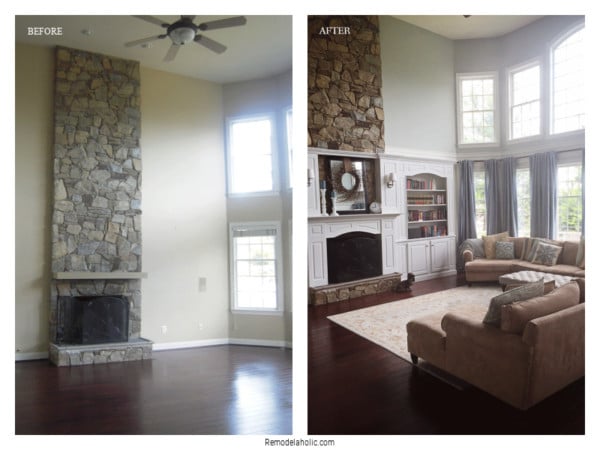
I did every last bit of the job entirely by myself. I had a general contractor come by to take a look at all of the trim work I did. He told me that if I’d hired him to do the work, he would have charged me at least $10,000. The wood for my entire project cost me about $1,500.

Paint colors are Benjamin Moore White Dove (white) and Restoration Hardware Silver Sage (light blue).

With Sherwin Williams Naval for the dark navy blue

I hired someone to paint it all after I finished installing trim.

Thank you so much for sharing your tips and your gorgeous home with us, Jenny!
Also check out:
- Jenny’s Kitchen Transformation
- 25+ Wainscoting Styles
- Tips for Caulking
- How to Install Board and Batten
- Installing Custom Wood Pre-Hung Doors | Basement Remodel
Please pin this for future reference!

Originally published 07.07.2015 // Updated 04.14.2021


Thank you for the chance to share some of my DIY adventures with Remodelaholic and the wonderful community of fellow DIY-ers out there!
Thank you for sharing with us again, Jenny! Your home is beautiful!
This is beyooond gorgeous. I am thoroughly impressed! We just purchased a home two weeks ago, and this is the VERY thing I was hoping to do with our new home! We already got a quote from a contractor who was calling out thousands of dollars for just the hallway and stairs. This post totally inspires me to try and do it myself, but… wow, I don’t know I’ve got what it takes. You are awesome!!
Thank you! Congratulations on the purchase of your home! I wish you the best of luck as you make it your very own. You CAN do it! It takes a lot of work, but it’s very satisfying to do it on your own. Just take it one step at a time and you’ll be a pro before you know it!
Wow! looks beautiful! Im impressed and you did great job! But, I have an unrelated question.. where did you get your large tan sectional couch? 🙂
Thank you! The couch is from Haverty’s. You can customize the configuration as there are several different sectional pieces to choose from. It’s called the “Amalfi” sectional. Ours is the color “peat.”
Absolutely beautiful!
Thank you kindly!
Whoa! That is nesting at it’s prime! Your stair wall even down to the original boob light at the top of landing looks exactly like my house. Thanks for the inspiration and high five for a job well-done!
Thank you! Yes, nesting gone crazy pretty much sums it up!
Both gorgeous and insane.
Thank you! Insane, to be sure! I agree! 🙂
Jaw-dropping inspiration! Great work you should be so proud! I’m complete awe.
Thank you for your kind words!
Looks amazing! I would love to know where your tv stand came from? Thanks!
Thank you! The TV stand is from Restoration Hardware.
Would you mind sharing the beautiful paint colors you choose for the After?
Of course! The blue-gray color is Restoration Hardware Silver Sage. The white color is Benjamin Moore White Dove.
I’d love to know too – love the color!
Sure! Paint colors are Benjamin Moore White Dove (white), Sherwin Williams Naval (dark navy blue), and Restoration Hardware Silver Sage (light blue).
What color did you use in the powder room?
AMAZING!! I am have been thinking about doing this. As soon as my kids go to school I am tearing into this project!! 🙂
You’ve got this! Go for it! It’s so rewarding to transform your space and do the work yourself! Good luck!
Wow! Your house has some serious class after putting all that trim up! I just keep shaking my head in amazement!
Thank you! I have visited your website before and have thoroughly enjoyed all the eye candy and inspiration!
Wow! Beautiful! As a beginner, I have a question: Do you work one room at a time? Which room have to be finished first?
Thank you! I did my project all at once. I’m not sure that’s the best way to do it though because you learn things as you go that help you later on. Starting with a bathroom or a smaller room is probably a good idea so that you know what you’re in for and how best to tackle the project. You’ll also find out whether you like doing it before committing to doing the whole house!
WOW!!! This is absolutely stunning. We are moving into a new house next week (yay!!) and we will be taking a lot of your expertise with us – and possibly copycat your powder room! Beautiful work!
Thank you! Congratulations on the new house and best of luck to you as you make it your own!
This is so absolutely stunning and I’m amazed/stunned that you tackled this at the end of your pregnancy and into the newborn stage. Absolutely jaw-dropping. Your home is gorgeous now and I love that you included such helpful tips and recommendations that it gives a really solid direction for any other diy-ers who want to follow your lead. Thank you for that awesome information!
So kind of you! Thank you! Yes, the timing was a little crazy, but sometimes you just have to jump in and do it or it never gets done!
Wow, that’s overwhelming with awesomeness.
You’re so very kind. Thank you!
Is the trim and shadow box areas all gross paint?
Hey there, Matthew! I’m not sure I understand your question. Does this help? The crown molding, chair rail, shadow boxes, baseboards, and the wall between the chair rail and baseboards are all painted the same color in an eggshell finish. The color is Benjamin Moore White Dove. If I misunderstood, please feel fee to ask again. Thanks!
Been stuck on getting crown moulding corners to match. Thanks for the tips and inspiration to keep trying. Ordered the book you referenced 🙂
Hi, there, Matthew! Good luck with your project! One more tip to help with getting crown molding corners to match . . . . Crown has that bottom beveled edge that slides up against the wall. Especially with longer pieces of trim, it can be tricky to ensure that the proper edge is up against the wall at the same distance from the ceiling along the whole length of the trim piece. This gets even trickier when you’ve got a second piece of trim on another wall that you have to join with the first piece in a corner. I found it helpful to do 2 things. 1) Start by putting a foot-long piece of crown with its back to the ceiling and then slowly slide it down in to place on the wall. I think it’s easier to get a feel for when the proper beveled edge on the bottom is in place when you do it this way. Then mark where the bottom hits the wall with a long pencil mark. Do this at several intervals along the length of the wall so that you have a guideline of where the crown needs to go. Do this for both walls. 2) Do the same thing at the corner where the 2 pieces of crown will have to fit together. Only this time, use two 1-foot pieces of crown, cut at the proper angle as if you were going to install them together in the corner. Play around with these 2 smaller pieces until you figure out where on the wall they each need to be in order to come together properly in the corner (walls are rarely exactly plumb and there is often variation in the wall and ceiling that you have to work with). Once you see where they need to be to fit, mark with a pencil. Then, when you go to put in your ‘real,’ full-length pieces of trim, you’ll know exactly how they have to fit against the wall in order to meet at the corner. I hope that makes sense! Kind of hard to explain, but I found it helpful to do it that way. Best of luck to you!
Oops! I said “Matthew” when I meant to say “Chris.” My apologies!
You never cease to amaze me Jenny! What a beautiful home! I’m inspired.
Thank you, Rebecca! Wonderful to hear from you!
I was amazed at how the trim tamed the volume of high ceilings……I just don’t want to dust in all.
Made me smile! Yes, dusting is an issue, no doubt!
Jenny, I am obsessed with the trim and how it transformed you house from common to absolutely custom and gorgeous! You are so talented and have impeccable taste! Do you have your own page? We are about to put together a workshop in our garage and turn our new “cookie cutter” house into something amazing, too ???? thank you for the inspiration!
Thank you for your kind words, Melissa. You made my day! I do not have my own page, nor do I have a public blog, but thank you for asking. Congratulations on your new house and best of luck to you as you make it your own!
You did an amazing job on your moulding! I am getting ready to do my dining room like this. I am struggling over spacing and how many panels to do on each wall. What spacing did you do between the panels and did you have a rule of thumb on sizing of the panels? Thanks for any help.