
Installing Trim: A Beginner’s Guide


Installing trim just got do-able for beginners! Crown molding, chair rail, window and door casing, and shadow box trim — Jenny did it all as a complete beginner and she’s sharing what she learned so you can do it, too!
More for you: Ultimate Guide to Wainscoting – DIY Craftsman Window Trim (with no angle cuts!) – Trim and Molding Tutorials and Tips

Installing Trim: A Beginner’s Guide
This post contains affiliate links, which allow us to continue providing you lots of DIY ideas at no cost to you. Learn more here
A quick Remodelaholic note: Before your pick up the perfect trim and start cutting, be sure to practice on an inexpensive piece of molding (or scrap) until you have an understanding of how the angles will work. Jenny recommends some resources below, so read up, watch some videos, and practice, practice, practice!
When I first opened the instruction manual for a compound miter saw, all I saw were warnings about the appendages one could lose if the saw was used improperly. I was so frightened and so intimidated that three months went by before I tried to use the saw again.
Unfortunately, power tool manuals are written for people who already know how to use the tools, not for DIY newbies like me. A manual won’t tell you the basics like how to release the blade lock. (It took me nearly an hour just to figure out how to do that!).

1. Research How to Install Trim

2. Create a Work Space

3. Acquire Tools and Supplies
- A Compound miter saw (a sliding compound miter saw is ideal, but a 12″ regular one will work just fine). I used a Dewalt.
- 18-gauge brad nailer (for shadow boxes) and 16-gauge finish nailer (for crown molding) and an air compressor. I bought them as a 3-tool Combo Kit and have been very happy with it.
- Brad nails and finish nails
- A ShopVac to clean up all the saw dust you’re going to generate. I found an 8-gallon wet/dry ShopVac at Costco.
- A 24″ level and 9″ torpedo level
- Measuring tape
- Multi-purpose protractor
- Pencil
- Wood Filler
- Sanding Sponge
- Caulk. After trying several, this DAP caulk is my favorite.
- Caulk Gun
- A crown molding chart that tells you what degrees to set your saw for cutting angles. I used the extensive chart available in the book Crown Molding & Trim: Install it Like a Pro, but I learned all the practical knowledge I needed for cutting crown molding on pp. 128-137 of the book Trim Complete, which has excellent pictures to accompany the clear instructions.
- A bag of pre-cut trim scraps labeled with their angles. I cut several different pieces of scrap trim (the ogee molding for shadow boxes and the chair rail molding) in increments by degree to use for figuring out angles. I preferred to use a protractor to measure angles for crown molding, but found that for chair rail and shadow boxes, it was faster to use my scrap trim samples. For example, I cut pieces of scrap chair rail at 15-degrees, 18-degrees, 20-degrees, 25-degrees, etc. Then, when I came across a corner where two walls meet, I’d hold up two pieces of my scrap trim (cut at different angles) until I found the 2 angles that came together for the best fit. That’s how I knew what angles to cut each piece of trim.
- The BuildCalc app and This Is Carpentry’s tutorial on how to use it. This app saved me all kinds of headaches when designing the shadow boxes. I simply measured the wall and figured out how many shadow boxes I wanted there to be and then entered the numbers into the app to find out the spacing.
- Trim Wood
- Ladder or tall step stool
4. Plan Out Every Detail
To come up with a design for my trim work, I browsed sites like Houzz and Pinterest for ideas.
(Remodelaholic note: We also have a post here with lots of wainscoting styles.)
Once I decided what I wanted to do, I measured all the walls and calculated how much wood I would need.
Word to the wise, give yourself plenty of overage. You won’t be able to use the entirety of every piece of trim and you will certainly make mistakes.
If you’ll be undertaking a large, multi-room project like I did, I recommend doing a small room first to get a feel for how much wood you’ll really need (it will be more than the exact measurements) and for how much time it takes.


The lumber yard also delivered (for a fee), which, given the size of my project, was enormously helpful. Store the wood indoors where you’ll be installing it and give it 3 or 4 days at room temperature before using it.
5. Draw on your walls.
I drew every last piece of trim on my wall before making any cuts or nailing anything in place. It’s a lot easier to make adjustments with pencil drawings than with wood.
I measured from the floor to the top of my chair rail molding, making a mark on the wall about every 18 inches. I then used my level to draw a straight horizontal line connecting all the marks so I would know exactly where to place the trim.
Same thing for shadow boxes. I measured then marked where they would go and used my level to draw straight lines connecting all the markings. Also, when I drew the lines, I measured them right then and wrote the measurements on the walls (I double-checked the measurements before cutting any wood.)

6. Nailing
I found that if I put a nail at each corner (not too close to the edge, though, or you’ll risk splitting the wood) and about every 8 to 10 inches, that was plenty.

7. Finishing
- Nail holes. Use wood filler, not caulk to fill your nail holes. Use a light hand with the wood filler as you’ll have to sand whatever dries on your trim. I suggest using a lightly-damp rag to wipe over newly-filled nail holes to minimize sanding later on.
- Sanding. Sanding sponges are great for carved moldings and most trim work with minimal wood filler to be sanded.
- Caulk. It will feel like you’ve caulked miles of seams, but do it! It will give you that seamless look where the wood appears to just grow out of the wall. As mentioned above, this is my favorite caulk (I tried several different kinds over the course of my project). Buy by the case to save money. You’ll use a ton of the stuff!
Get tips for caulking like a pro here.

I put up hundreds of feet of trim: chair rail, crown molding, and dozens of shadow boxes.

(The shelves and mantel around the fireplace in the family room were built by a carpenter, not me).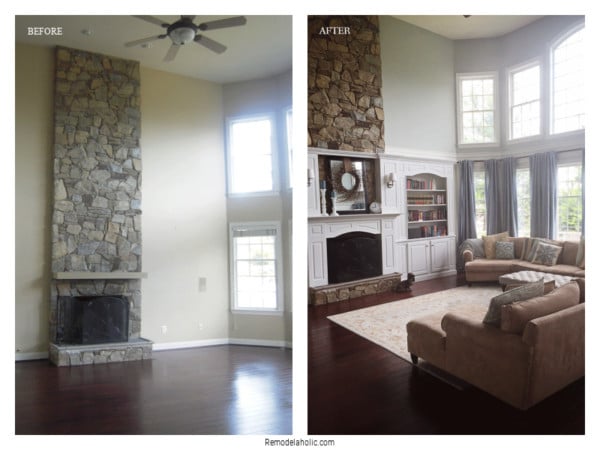
I did every last bit of the job entirely by myself. I had a general contractor come by to take a look at all of the trim work I did. He told me that if I’d hired him to do the work, he would have charged me at least $10,000. The wood for my entire project cost me about $1,500.

Paint colors are Benjamin Moore White Dove (white) and Restoration Hardware Silver Sage (light blue).

With Sherwin Williams Naval for the dark navy blue

I hired someone to paint it all after I finished installing trim.

Thank you so much for sharing your tips and your gorgeous home with us, Jenny!
Also check out:
- Jenny’s Kitchen Transformation
- 25+ Wainscoting Styles
- Tips for Caulking
- How to Install Board and Batten
- Installing Custom Wood Pre-Hung Doors | Basement Remodel
Please pin this for future reference!

Originally published 07.07.2015 // Updated 04.14.2021


Hi, there, Kim! Thanks for your kind words! Good luck with your dining room project! I think you’ll find that you’ll be thrilled with the look of trim work, in a dining room especially. Have fun! Most people suggest using the rule of thirds when determining what height for a chair rail. I have a 9-foot ceiling on my main floor, so my chair rail starts at 36-inches up from the floor. As for the shadow boxes or panels, I did 2.5″ on all sides of the box (that’s 2.5″ inches between the bottom of the chair rail and the top of the box; 2.5″ between the boxes; and 2.5″ inches between the bottom of the box and the top of the base board). To determine how many shadow boxes to put on a wall, I found the BuildCalc App to be enormously helpful. There’s a great tutorial here (https://www.thisiscarpentry.com/2012/07/20/wainscoting-buildcalc/) that tells you how to use the app for calculating the distance between panels. I would start by taking a guess at how many panels I thought would look good on a wall and then I’d enter all the pertinent measurements in to the app to find out what the spacing would be with that number of panels. I did that for each wall in the room and kept working the number of panels until I could get panels very close in size for all walls. If your walls are different lengths or have obstacles like doors or windows, you’ll find that you can’t always get your panels that exact same size as they are on the opposite wall, but you want something pretty darn close (where possible). That’s where the app came in handy in simplifying a lot of the math. I think a lot of it comes down to personal preference, too. In my approximately 14-foot x 12-foot dining room, my panels (from outside edge to outside edge) are about 36″. On the shorter wall, though, I have a large window, so my boxes aren’t anywhere near 36″ like they are on the long sides of the room, but it all works because I kept the standard 2.5″ between everything consistent. I highly recommend looking at pictures on Pinterest or Google Images or Houzz because as you see the way it’s been done, you’ll get a better idea of what you like best and you can copy that look and spacing. Good luck!
Hi Jenny,
Amazing works! Whats the type of panel molding you used, did you customized it or they came standard with CAD? I’m interested in using a similar style for my home project but cant seems to find one close.
Wow! Hard to find the words to congratulate you on the transformation of your house. It is stunningly gorgeous! I normally do not like these vast open 2 story living areas as they look empty and awkward to decorate. The trim has really brought the scale of the room back to a cozy proportion, white trim from above the curtains to the floor and the wonderful blue above. The tall rock fireplace has even been amazingly customized! I can’t believe you did it all yourself but certainly well done!
Thank you for your kind words, Lori! I think you’re spot on about the trim bringing in the scale of the room to make it cozier.
First I have to say WOW! very impressive!! I do have a question that is totally unrelated, in your first before picture (of the stairs) is that a window under the staircase? Like I said it is totally unrelated but I can’t find an explanation anywhere and it is driving me crazy (as if I’m not already!). Again, love what you did!
Sure! No worries! You’re not crazy. It’s impossible to tell what it is from the picture. It’s a built-in media cabinet put in by the previous owners of the house. It provided shelving under the stairs for storing electrical equipment, like the cable box and DVD player. Those are glass doors you see on the outside. I had no use for the cabinet and so removed the glass doors and drywalled over it. Always painful to lose storage, but it had to be done! 🙂
I am dying to know how you pulled off the built-ins around the fireplace?! We, too have a two-story fireplace that is flush against the wall, and would like to do built ins. We have had contractors come to provide estimates, and all of them involve doing build-outs, causing the fireplace to be in a “channel” between the sides of the shelving. Might I ask how deep your shelving is, and if the space in the cabinets is functional? This is perfect!!!
Sure thing! Happy to help if I can. I think I understand what you’re asking, but if I don’t get it right, please ask again! So, the mantel and shelves are not built in to the wall. They’re just like a piece of furniture, only instead of just standing in front of the wall, they’re attached to the wall. So, you’re distinction of a ‘built-out’ is what would best describe them. They come out from the wall. The fireplace is a ‘channel’ in between the two shelving units, with the mantel wrapping around the fireplace and the shelving and cabinets flanking it on either side. All of the cabinets are fully functional. The shelving units come out 13″ from our wall, but if you’re having a custom piece built, you could decide what depth you wanted. By design, the mantel sticks out a little bit farther than the shelves on either side. Good luck!
I don’t have anything new or clever to add to all the comments above mine, so I’ll just say it’s amazing, I love it all, and WOWZA!
So very kind of you to take the time to say something so nice. Thank you!
Hi Jenny,
I absolutely love all the trim work you did around your beautiful home. Thank you for such a detailed outline of how to get such a great result. I am planning to do similar trim in our dining room, hallway and family room. Could you please tell me what sheen level you used for all the walls with white dove trim?
Thanks so much!
Thank you for the kind words. Happy to answer your question . . . the trim, the walls, and the ceilings are all in an eggshell finish. Good luck with your project!
Beautiful! Can you share where you found the huge couch?
Thanks so much
Hi Shelly! I believe Jenny answered that in the comments above ^^. Thanks!
Ugh, you are awesome! I think you should add “step 1: commit”. Lol. I toyed with the idea of adding trimwork to my upstairs bathroom, and it wasn’t until i cut a big hole in the wall that i really got started. I found that i love to build things a few years ago, and i have been wanting to add trimwork to my living areas, but i have one problem. The walls are not smooth. From what i found recently, you cannot get really thin board that is smooth to use as a base. I would have to smooth it myself, with mud or something, which sounds like a total pain in the arse. Any ideas? For the bathroom I did, I used a really thin sheet of paneling, but the paint doesn’t hide the wood grain. It just happens to not bother me up there. I don’t want that downstairs though. Would love your suggestions.
Hi, there! I’m not a professional by any means, but it’s my understanding that yes, the best way to smooth out a wall is with a skim coat. The materials and the methods used will depend on whether you have plaster walls (found in older homes) or drywall. That’s just if the surface is uneven, though. If your walls are bowed, a bigger fix is needed. Applying a skim coat takes some practice, but there are some great tutorials online for learning how to do it. Now, as for the board idea. In high-end trim installation, a piece of wood paneling goes in between the wall and the trim work. It’s cheaper and faster to apply the trim directly to the wall (which is what I did), but for really high-quality installations, it’s not done that way. You could most certainly use a panel board between the wall and your trim to achieve a smooth look (the wall might not be smooth above the board and trim are, though, so you’d still have to address that problem). To avoid having wood grain, be sure to purchase a smooth-finish, high-quality piece of plywood. Buy pieces that have minimal wood grain (and no knots or blemishes). And, when you’re done installing it, use good-quality paint: both primer and paint and you should be able to hide any grain. Best of luck to you!
This is an amazing transformation. Absolutely gorgeous. Such a classic look and truly inspiring! Wonderful job.
So kind of you! Thank you!
I am speechless – jaw-dropping gorgeous! I’ve been wanting to do moulding myself for years (I’m 56) and you have inspired me. You deserve to be crowned the “Queen of Inspiration”. I’m also amazed at the detailed instructions and the time you have put info your responses – sharing your tips; you have helped so many of us wanting to tackle a project. Want to be my new best friend?
So very kind of you! Thank you! There are plenty of people out there in internet-land who have inspired me with their projects. It’s a pleasure to be able to pass some of that goodness on! I never would have imagined doing DIY until seeing that other people had done it and succeeded. I so hope you’ll tackle your own project—it’s a lot of work, but so rewarding in the end! Good luck!
Hi….could you please tell me what color the wall paint is on the wall in the powder room, it’s perfect. Thanks!!
Sure thing! It’s Benjamin Moore Revere Pewter! I love it so much, I’ve used it in my powder room, my pantry, and one of my kid’s bedrooms. Great color!
WOW! Love it. Been researching DIY wainscoting for family room where most people do 1 room, not most of the house:) Under your situation it’s unimaginable! Gotta know how you choose to tackle high ceilings? With all the choice of moldings, what did you pick for chair rail and shadow boxes? Again, my congratulations on a wonderful job most people would never consider:)
Hi, there, Dennis! Thank you for the kind words! High ceilings are a challenge, to be sure. I used a 15-foot tall ladder, in addition to a standard ladder, for the trim work I did in my home. If that isn’t tall enough for your ceilings, you’d probably have to look in to renting scaffolding or a heavy-duty ladder from a contractor or construction rental company. I picked very standard and readily available pieces of trim for the chair rail and shadow boxes. Every big box store carries a variation of the stuff I used. For fancier options, you can order directly from trim manufacturers online or go to your local lumber yard. Trim molding comes in different profiles (a profile is what the molding looks like from the side) and sometimes the same profile comes in different sizes. For the shadow boxes, I used base cap molding. Again, just a standard, widely-available profile. Good luck!
Just beautiful! I love every single inch of your home. I also have a two story family room and have been wanting to do the shadow boxes as well. It’s my next project actually!
Could you tell me where you purchased your upstairs hallway light fixtures? I want to put light fixtures where my can lights are for more of a cozy look. Thank you!
Thank you for your kind words! I’m excited for you to undertake your own trim project—you’ll find that it makes such a difference! My upstairs hallway light fixtures were purchased from Pottery Barn. Good luck!
You have great ideas but I tried to build your “window cornices” following your directions and wasted a whole piece of ogee trim ( very expensive) trying to finish it up. Needless to say it’s still sitting unfinished because I don’t know how to cut miter pieces using your horrible directions. I spent hours on the internet trying to find out how to cut it but there are none so, I wasted a lot of money on a project because I don’t know how to cut trim. Your directions make it sound like no big deal, but that’s not reality….. How disappointing!
I’m so sorry to hear that your window cornice project didn’t turn out as you had hoped. Being self-taught, I have had many disappointments myself as I’ve learned how to cut trim through trial and error. It definitely takes practice and I would encourage you to not give up. Practice on scrap pieces or inexpensive pieces of trim until you feel confident in your cuts. Ogee trim, in particular, can be a challenge, for sure. Is there a specific question you have that I could answer for you? Are you using a miter saw to make your cuts or a miter box? In writing the tutorials, there is the assumption of a basic level of familiarity with woodworking tools, so I can understand how, if you haven’t made miter cuts before, it could be confusing. I’d be happy to help if I can!
I am completely impressed by your gorgeous house and the fact that you did it yourself! We’re tackling a small powder room project, and I LOVE yours. Can you please tell me the toilet and sink brand and where you got the mirror? I love it all! Thanks!